
An ecommerce SEO strategy decides which product and category pages should own search demand, where supporting guides belong, and whether organic discovery produces useful commercial activity. The first task depends on the store. A new catalogue should not follow a faceted marketplace's plan, and neither should a redesign.
Use this operating sequence to identify the current constraint, choose what waits, and assign each release to an owner. It is written for ecommerce websites in India, including D2C brands, retailers and marketplaces. The underlying decisions apply to any changing product catalogue.
Start with store state, not a list of ecommerce SEO tips
Two stores selling similar products can have different constraints. Diagnose the operating state before approving content, development or authority work.
| Store state | First question | First workstream | What should wait |
|---|---|---|---|
| New store | Which demand deserves a category, product or guide owner? | Demand map, taxonomy, URL and measurement design | A large editorial calendar |
| Existing store with indexation problems | Can search engines reach and select the intended pages? | Crawl, rendering, status, canonical, internal-link and sitemap diagnosis | New filtered landing pages |
| Store with traffic but weak sales | Are queries landing on the correct product group? | Query-to-page analysis plus catalogue and conversion diagnosis | Generic traffic articles |
| Large catalogue with duplication | Which combinations have distinct demand and usable inventory? | Facet policy, variant model and canonical ownership | Programmatic page expansion |
| Migration or redesign | Which current URLs and page signals must survive, and what content must remain? | Inventory and URL mapping, followed by parity checks, redirects, launch control and rollback planning | Unrelated architecture experiments |
| Mature store with a plateau | Where is evidence or demand coverage missing? | Gap analysis, page improvement, original assets and authority | Rewriting every page on a schedule |
This table is the control layer. It prevents an ecommerce team from treating keyword research and technical fixes as simultaneous with category copy, internal links or schema. Engineering, merchandising, content and analytics capacity is limited. A useful plan records dependencies and names the person responsible for the next release.
The ecommerce SEO strategy in ten decisions
| Order | Decision | Primary owner | Release check |
|---|---|---|---|
| 1 | What counts as success? | Founder, ecommerce lead and analytics | Baseline and measurement note |
| 2 | Which page owns each query job? | SEO and merchandising | Query-to-canonical map |
| 3 | How do products relate through the catalogue? | Merchandising, UX and SEO | Navigation and internal-link crawl |
| 4 | Which URLs can be crawled and indexed? | SEO and development | Rendered crawl and status codes, plus canonical and robots checks |
| 5 | What decision does each category page complete? | Merchandising and content | Product-set and filter checks, followed by copy and link review |
| 6 | What facts define each product? | Product operations | Visible record plus variant and offer checks |
| 7 | Do page, schema, feed and inventory agree? | Product operations and development | Representative product validation |
| 8 | Which questions require editorial support? | Content and merchandising | Brief, evidence and commercial handoff |
| 9 | Why would another source reference this store? | Brand, PR and SEO | Editorial relevance and destination value |
| 10 | Did the release improve the selected page group? | SEO, analytics and ecommerce | Dated impact review with confounders |
The sequence can loop, but it should not be inverted. More articles cannot repair a catalogue whose preferred category pages are inaccessible. A canonical tag cannot repair conflicting internal links. Product schema cannot repair a wrong price on the visible page.
Step 1: define the commercial and measurement boundary
Search Console, analytics, order systems, product systems and finance tools observe different events. Before changing a page, define the event each system can support.
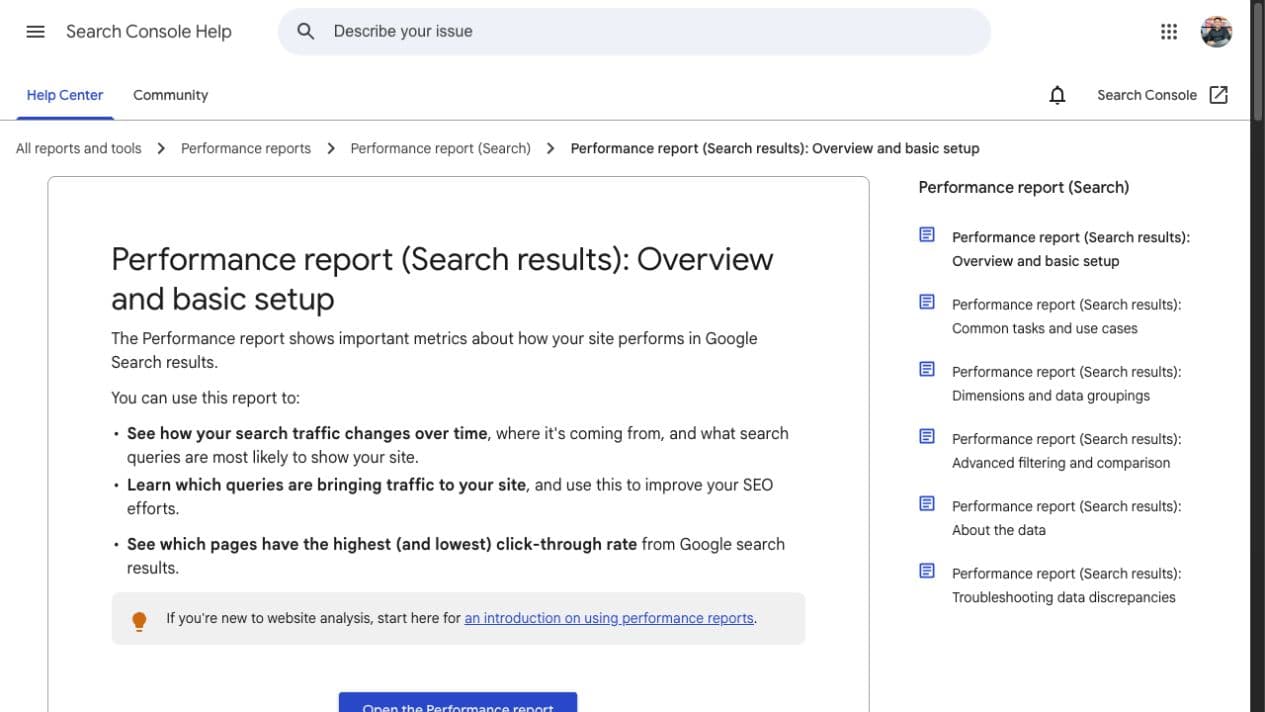
Google’s Search Console Performance report defines clicks, impressions, click-through rate and average position, with dimensions such as query, page, country, device, search appearance and date. Those are search visibility measures. They are not sessions, orders, recognised revenue or profit.
Build a baseline by page group rather than total site traffic alone:
- mapped query impressions, clicks, CTR and average position;
- indexable canonical URLs by category and product type, plus guide pages;
- organic landing sessions under the analytics consent model;
- product discovery, add-to-cart, checkout and completed-order events;
- cancellations, returns, refunds and RTO;
- average order value, margin or contribution where finance can support it.
Do not force those layers into one headline number. A Search Console click can fail to become an analytics session. An analytics purchase can later be cancelled. Finance revenue can differ from event value.
Keep the layers separate.
For every release, retain the affected URLs or templates, owner, launch date, baseline window, comparison window and known confounders. Stock, price, promotions, paid campaigns, brand demand and seasonality can move at the same time as SEO work.
Step 2: map search demand to one canonical page owner
Keyword research becomes useful when it ends in ownership. Group queries by the decision behind them, then assign one page that can satisfy the job.
| Query job | Typical ecommerce owner |
|---|---|
| Broad product class | Department or category page |
| Narrow product type or stable attribute set | Subcategory or collection |
| Exact purchasable item | Product detail page |
| Product family, model or variant group | Product-family owner with controlled variants |
| Comparison or selection question | Buying guide or comparison page |
| Usage, care, compatibility or explanation | Guide linked to the relevant commercial owner |
| Brand plus product or category | Brand landing page, collection or product owner |
| Delivery, returns, warranty or support | Policy or service page |
Several keyword variants can belong to one page. A new URL is justified when the search result job, eligible catalogue and answer differ enough to support a distinct owner. Search volume alone is not a page-creation rule.
Save the map. For this page, we keep six measured India keyword mappings, the DataForSEO task, collection date and excluded commercial intent. A product catalogue needs the same discipline. Without it, commercial pages and editorial pages can compete for the same query while none provides a complete answer.
Step 3: turn page ownership into catalogue architecture
Build outward from the products the business can actually sell. A common relationship is home → department → category → subcategory or collection → product. Buying guides and glossary definitions support that commercial chain.
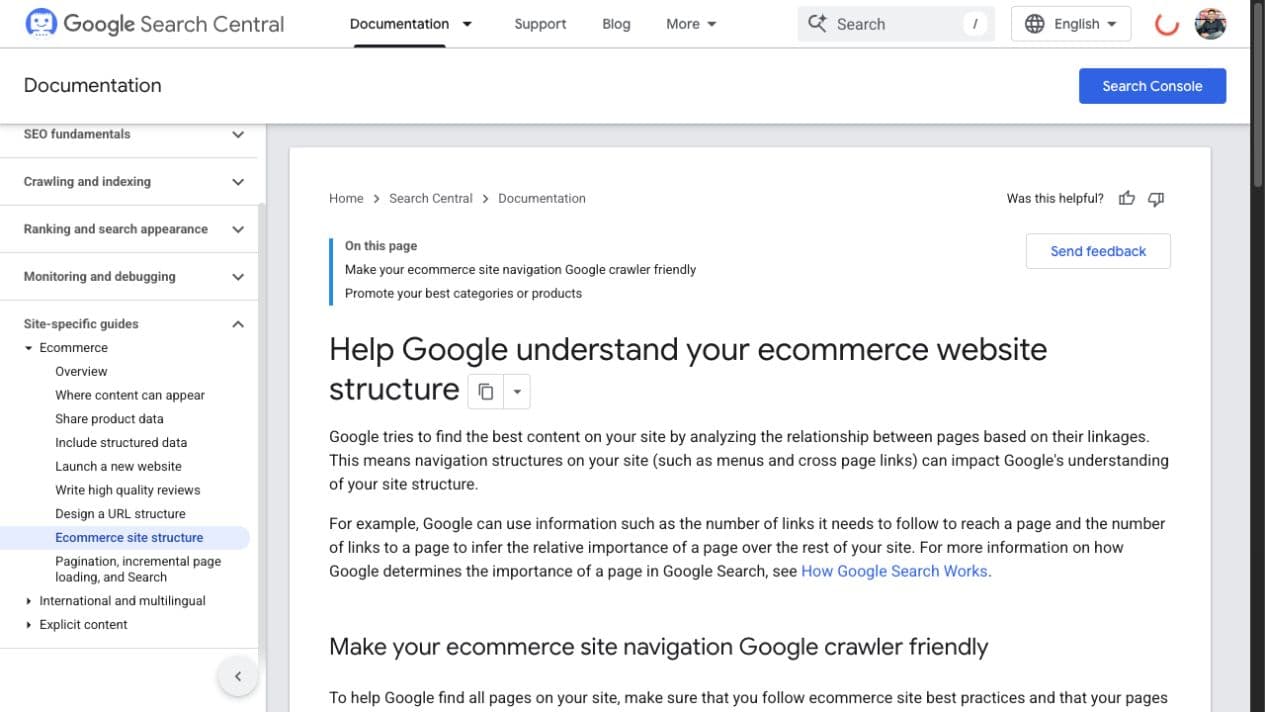
Google explains that it uses page linkages to understand ecommerce structure. Its ecommerce site-structure guidance recommends crawlable links from menus to categories, subcategories and products. Products reachable only through an internal search box may not be found through crawling alone.
Search boxes are not navigation.
Architecture decisions include:
- permanent taxonomy and temporary merchandising collections;
- hierarchical links between levels, plus sibling and related-product links;
- product families and variant rules, including bundles and packs;
- brand, compatibility, concern, material, ingredient and use-case attributes;
- navigation and breadcrumbs;
- pagination or incremental loading;
- filter combinations that stay user-only;
- internal-search results that should not become organic landing pages.
An indexable collection needs distinct demand, useful inventory, original decision support and durable internal links. A set that disappears when a campaign ends is a weak canonical owner. A stable “waterproof hiking shoes” collection may deserve ownership; an arbitrary price-and-sort combination usually does not.
There is no universal click-count rule that proves quality. The test is whether shoppers and crawlers can reach the important page through meaningful links and understand how it relates to the catalogue.
Step 4: control crawling, indexation, canonicals and facets
Technical ecommerce website SEO should confirm that search engines can discover and interpret the intended URLs, then select them for search. Begin with evidence from a rendered crawl, server responses, Search Console, sitemaps and live templates. Add log data when it is available and reliable.
Review:
- response codes and redirect chains;
- robots rules and accidental blocks;
- canonical annotations and selected canonicals;
- internal links in rendered HTML;
- sitemap membership and meaningful last-modified dates;
- parameter, filter, sort and internal-search URLs;
- pagination and infinite-scroll accessibility;
- JavaScript rendering for products, links and structured data;
- discontinued, out-of-stock and replaced-product rules;
- mobile performance and layout stability.
Google warns that parameter-based faceted navigation can create very large URL spaces, which can consume crawl resources and slow discovery. The answer is not “noindex every filter.” First separate durable search landing pages from shopper-only refinements and invalid states.
For duplicate or closely similar pages, Google lists redirects and rel=canonical as strong canonicalisation signals and sitemap inclusion as a weaker signal in its canonical guidance. These signals should agree. A canonical annotation cannot compensate for a navigation and sitemap that keep promoting another URL.
Fix template-level causes before correcting thousands of pages one at a time. Verify representative categories and product types after every release. Include out-of-stock items, pagination and approved filter landing pages in that sample.
Step 5: make category and collection pages decision owners
Category pages often own the broadest non-brand commercial demand. They need more than a product grid, but they do not need a long essay inserted above every item.
A useful category owner can provide:
- a precise heading and product-set boundary;
- accessible subcategories and selection paths;
- filters built from governed product attributes;
- concise decision support where the shopper needs it;
- crawlable links to eligible products;
- current price and availability through the product set;
- links to relevant comparisons, guides or definitions;
- unique metadata and breadcrumb relationships.
Place help near the decision. Size advice may sit beside size filters. A comparison link can appear where materials or use cases diverge. Essential category meaning should not be hidden in collapsed footer copy written only for keyword coverage.
The category page SEO guide owns the detailed implementation. This strategy page controls when category work comes before product or editorial expansion.
Step 6: treat product pages as governed entity records
A product page represents a purchasable item or product family. It should identify the product and variant, state the current offer, answer the purchase decision and connect back to the catalogue.
Depending on the sector, governed fields can include:
- name, brand, product type, model and identifiers;
- material, ingredients, dimensions, size, colour or shade;
- pack quantity, compatibility, use and care;
- warnings or restrictions;
- price, currency, availability and condition;
- delivery and returns, along with warranty terms;
- original images and eligible reviews.
Accuracy beats volume. Supplier copy may be duplicated across retailers and still fail to answer the store’s customer questions. Replace it with governed facts, original images and useful help, not interchangeable prose.
Unavailable products need a rule. A temporary stockout can retain the owner and show substitutes or notification. A discontinued item needs an archive, redirect or removal decision based on demand, equivalence, links and customer value. Sending every retired product to the homepage is not a product strategy.
The product page SEO guide owns the detailed page system.
Step 7: align visible product facts, structured data and feeds
Search systems can receive product information from the visible page, structured data and Merchant Center. The store may also have a separate inventory or product-information source. Identity, price, currency, availability, condition and offer details should agree.
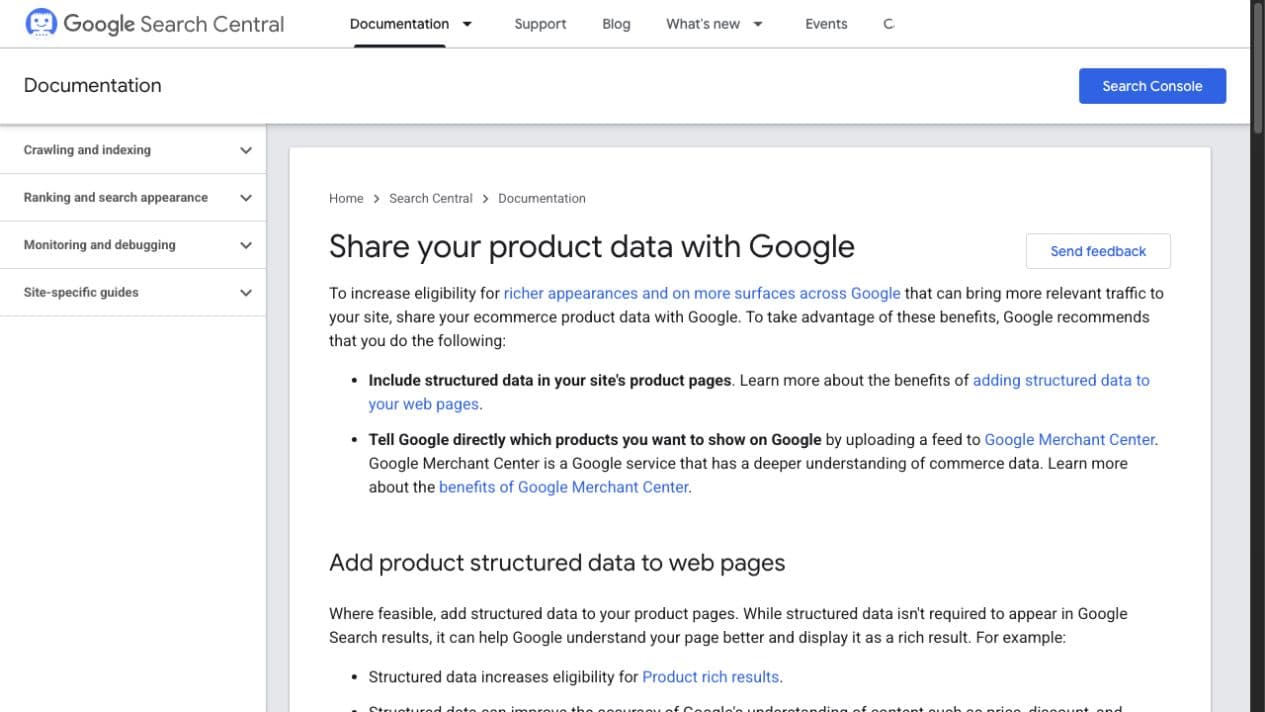
Google recommends product structured data and a Merchant Center feed as complementary channels in its product-data guidance. Feeds can give larger or frequently changing catalogues more control over update timing. Merchant Center is not mandatory for ordinary Google Search appearance, but it is required for some surfaces such as the Shopping tab.
Use Product markup that fits the visible page. Google distinguishes merchant listings on purchasable pages from product snippets on pages where a product cannot be bought directly in its Product structured data documentation. Eligibility for a rich appearance is not a ranking or display guarantee.
Do not add ratings, shipping, returns or availability to markup when the page does not support the fact. Validate simple products and variants first. Then test discount handling and stockouts. Include products without reviews in the sample. Fix discrepancies in the source system instead of generating a plausible value at render time.
Step 8: build editorial content around the catalogue
Editorial content should complete questions that categories and products cannot finish. Useful jobs include selection criteria, comparisons, compatibility, sizing, application, care, maintenance, troubleshooting and original research.
Each article needs:
- one explicit user job and canonical owner;
- a relationship to relevant categories or products;
- evidence for material claims;
- an original contribution or useful synthesis;
- internal links that continue the reader’s task;
- a visible review date and change trigger.
Do not manufacture a page for every long-tail variation or AI fan-out. Consolidate related questions when one answer serves the same decision. Create a separate owner only when evidence, structure and next action are genuinely different.
The ecommerce SEO checklist remains an execution asset. The what is ecommerce SEO guide remains the definition owner. This page stays responsible for sequencing.
Step 9: earn authority from real business activity
Authority work should give another source a defensible reason to reference the store or its evidence. That reason may be an original dataset, useful tool, product innovation, expert contribution, founder event, partnership, research project or strong category resource.
Do not treat link counts as an isolated production target. Review whether a link is editorial, relevant to the entity, likely to remain and connected to a destination worth discovering. Brand mentions without links can reveal missing relationships, but they should not be reported as backlinks.
If the store has no referencable asset, fix that before scaling outreach. The ecommerce link-building guide owns the detailed authority process.
Step 10: release and measure one controllable page group
A broad quarterly objective such as “grow organic traffic” is difficult to diagnose. A controlled release defines the affected group and expected intermediate movement.
Examples include:
- a revised page-owner map for one category cluster;
- move one filter family from crawlable noise to controlled landing pages;
- correct visible and structured data in one product template;
- apply a discontinued-product rule to a reviewed set;
- connect one guide cluster to its commercial owners.
After launch, ask:
- Has the intended page gained the mapped query set?
- Is a sibling page losing or duplicating ownership?
- Are crawling and indexation moving towards selected URLs?
- Has product discovery improved from the landing group?
- What changed in completed commercial outcomes after cancellations and returns?
- Could inventory, price, promotion, season or brand demand explain the movement?
Impact checks at two and four weeks can catch technical regressions. Category and authority work may need longer observation, but the next review date should still be scheduled.
How platform differences change execution
The operating sequence stays stable across platforms, but control surfaces change.
- Shopify: test theme output, collection logic, app conflicts and platform URL constraints. Use the Shopify store SEO guide for platform decisions.
- WooCommerce: inspect WordPress templates and plugins first. Then check taxonomies and hosting. Database behaviour needs a separate look when catalogue queries or plugins slow the response. Use the WooCommerce SEO guide.
- Magento or Adobe Commerce: inspect configuration scope and catalogue paths. Layered navigation and rewrites need explicit policies. Treat caching and deployment as separate operational checks. Use the Magento SEO guide.
- BigCommerce: inspect category/product templates, faceted search, storefront rendering and platform configuration. Use the BigCommerce SEO guide.
- Custom or headless commerce: verify the rendered frontend, internal links, API-dependent content, cache behaviour and release ownership rather than assuming the commerce backend controls search output.
Choose implementation guidance only after naming the platform and storefront together with the deployment model.
Where AI search fits in the strategy
The captured India result contained an AI Overview. Google also says AI Overviews and AI Mode may use query fan-out across subtopics and data sources in its AI features guidance.
Google states that the same SEO practices remain relevant and that there are no additional technical requirements, special schema or separate AI text files required for eligibility. A page must still be indexed and eligible to appear with a snippet. Eligibility does not guarantee crawling, indexing, serving or citation.
For an ecommerce store, that keeps the priority clear:
- make important pages crawlable and internally linked;
- express product and category relationships explicitly;
- keep visible facts, structured data and feeds consistent;
- answer real comparison and usage questions in useful passages;
- support material claims with evidence;
- use original images and videos where they improve the decision.
Track AI visibility as a separate observation layer when the method is repeatable. Record the platform, prompt set, date, market or account state, cited source and response. Do not merge an AI mention count with Search Console clicks or call it revenue.
A monthly ecommerce SEO operating rhythm
Run the system as a recurring decision cycle:
- compare mapped queries with their canonical pages;
- inspect template, crawl and indexation changes;
- review category, product and feed data quality;
- select one controllable page group;
- release with an owner, date and measurement note;
- check impact and unintended effects;
- refresh material claims and evidence assets;
- feed the result into the next priority decision.
Monthly review does not mean rewriting every page monthly. It means checking whether demand, products, platform behaviour, evidence or search guidance changed enough to justify work.
Most months, only one layer moves.
Frequently asked questions
How do you create an ecommerce SEO strategy?
Classify the store state, define measurement boundaries, map query jobs to canonical page owners, build crawlable catalogue relationships, control indexation, improve category and product systems, align product data, then release and measure one page group at a time.
What should a new ecommerce website do first for SEO?
Begin with demand mapping and taxonomy before producing a large content calendar. Set URL ownership next, then design navigation and measurement. It is easier to preserve a sound structure than to repair thousands of conflicting URLs later.
Should category pages or product pages be optimised first?
It depends on the constraint. Category work usually comes first when broad non-brand demand lacks a stable owner. Product work comes first when purchasable records are inaccurate, duplicated or inconsistent with inventory and feeds. Broken crawl or canonical controls can precede both.
How often should an ecommerce SEO strategy be reviewed?
Review mapped queries, technical changes and catalogue data monthly. Schedule deeper content and evidence recertification at least quarterly, and review sooner after a migration, platform change, product-data change or material Google documentation update.
Does ecommerce SEO help with AI Overviews and AI Mode?
The same accessible, indexed and useful pages support eligibility in Google’s AI features. Google does not require special AI schema or a separate AI text file. No implementation can guarantee that a page will be cited.
Can an ecommerce brand handle SEO without an agency?
Yes, if the team can assign technical and merchandising ownership. Content and analytics need named owners too, as does the release itself. Outside help is useful when the constraint spans several systems or the team needs an independent catalogue-wide diagnosis and implementation plan.
Originally published: 10 August 2025
Reviewed and rebuilt: 24 August 2026
Next accuracy review: 24 September 2026
Next deep evidence review: 24 November 2026