Category Page SEO: The Complete Guide to Ranking Ecommerce Category Pages
Category pages connect broad product demand to a browsable, purchasable set. Their job is to identify the category, expose useful choices, help shoppers narrow the set and give search systems a stable canonical page to understand. This guide covers the content, merchandising, internal-link and indexation decisions behind that job.
Table of Contents
Why Category Pages Matter for Ecommerce SEO
Category pages are the highest-value pages in your ecommerce SEO strategy. They target the broadest, most competitive commercial keywords in your niche—terms like "men's running shoes," "wireless headphones," and "organic skincare products." These head terms carry enormous search volume and represent shoppers who are actively considering a purchase but have not yet narrowed down to a specific product.
While product pages capture specific, long-tail queries from buyers who know exactly what they want, category pages capture the much larger pool of shoppers who are still exploring options. A well-optimized category page acts as a gateway into your catalog, channeling organic traffic through your product grid and filtering system until the shopper finds exactly what they need.
Category pages vs. product pages in search
Understanding the relationship between category pages and product pages is essential for effective ecommerce SEO. They serve different intents and target different types of keywords:
- Category pages often own product-class demand — These queries indicate that the shopper knows the type of product but is still evaluating a set. Validate the actual India demand for each category rather than assuming volume.
- Product pages target long-tail terms — Specific, lower-volume but higher-converting keywords that indicate purchase-ready intent. The shopper is looking for a particular product and is ready to buy.
- Category pages feed product pages — When a category page ranks for a head term and a shopper clicks through, they browse the product grid and eventually land on a product page. This organic funneling effect means category page rankings directly drive product page conversions.
Model the commercial opportunity with your own data
Start with the category's Search Console impressions, clicks and query set, then connect organic landing sessions to product views, add-to-cart events, completed orders and contribution. If you model a ranking or click-through change, label it as a scenario rather than a forecast.
Prioritise category pages where verified demand, catalogue depth, commercial value and current underperformance intersect. A page with higher search volume is not automatically the best first project.
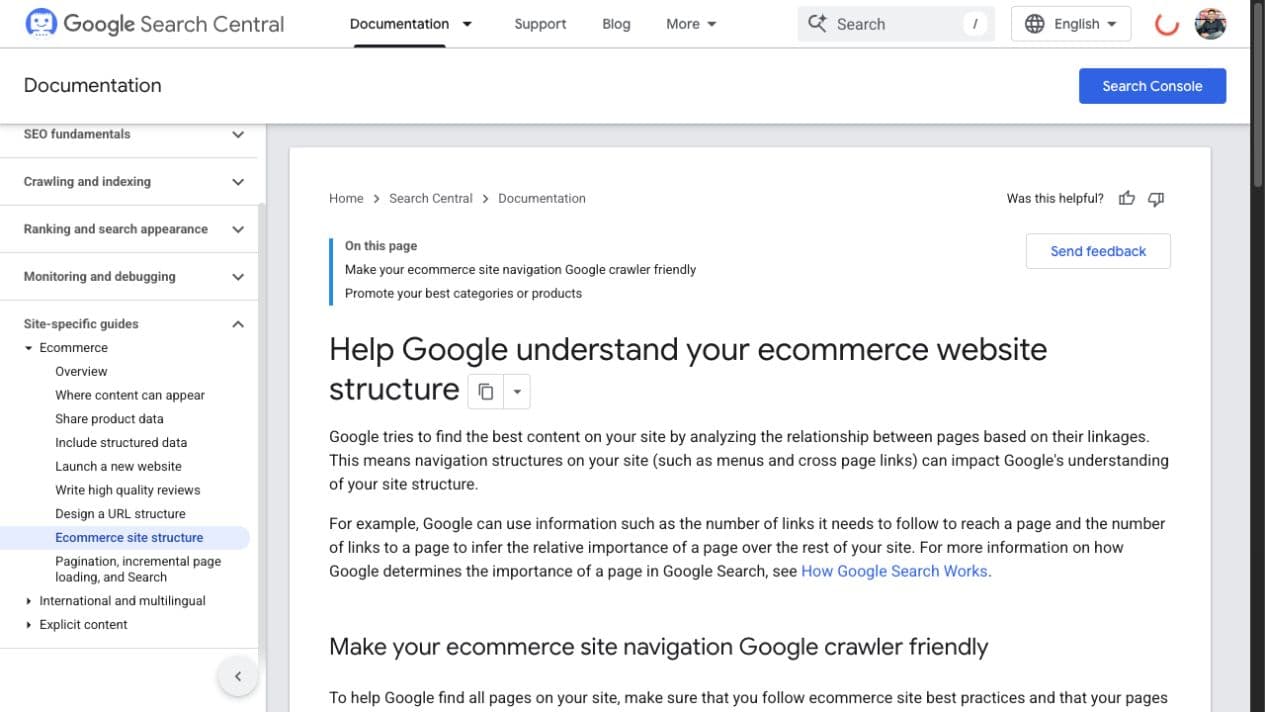
Category Page Architecture
The architecture of your category pages determines how effectively they rank, how easily users navigate your catalog, and how efficiently search engines crawl your site. Getting the structural foundation right is essential before layering on content and optimization.
Category hierarchy and depth
Your category hierarchy should mirror how shoppers think about your products, not how your warehouse organizes inventory. A clear, intuitive hierarchy makes it easy for both users and search engines to understand the relationships between categories and products.
- Top-level categories — Broad product types that appear in your main navigation. Keep the set understandable and based on real catalogue and demand relationships; there is no universal maximum.
- Subcategories — More specific groupings within each top-level category. "Shoes" might have subcategories for "Running Shoes," "Hiking Boots," "Casual Sneakers," and "Dress Shoes."
- Deeper categories (use deliberately) — "Shoes > Running Shoes > Trail Running Shoes" makes sense when the set, shopper decision and search demand justify a stable page. Evaluate click depth and navigation clarity rather than enforcing a universal number of levels.
URL structure for category pages
Category page URLs should be clean, descriptive, and reflect the hierarchy without unnecessary depth. The ideal pattern is:
- Top-level: /shoes
- Subcategory: /shoes/running-shoes
- Sub-subcategory: /shoes/running-shoes/trail-running-shoes
Preserve stable platform paths when changing them would create migration risk. URL folders can communicate organisation, but an extra directory does not mechanically dilute ranking value. Use readable lowercase slugs and map each canonical URL to one intent.
Category page template elements
Every category page should include these structural elements for optimal SEO:
- Unique H1 heading — The category name with the primary keyword. "Men's Running Shoes" is better than "Running Shoes" because it targets a more specific, higher-converting keyword.
- Introductory guidance near the product grid — Enough context to identify the category and help the shopper, without delaying product discovery.
- Product grid with filtering options — The core product listings with sort and filter controls.
- Deeper decision support — Add buying, compatibility, material, sizing or care guidance only where the category needs it.
- Breadcrumb navigation — Showing the path from homepage to current category.
- Pagination controls — Clear navigation to subsequent pages of products.
Content Strategy for Category Pages
Category page content is the most underinvested element in ecommerce SEO. Most stores display a product grid with a title and nothing else, then wonder why they cannot rank for competitive category keywords. Google needs substantive, unique content to understand what a page is about and whether it deserves to rank above competitors who may have stronger domains or more backlinks.
Above-the-fold introduction
The introduction text near the product grid should identify the category and help shoppers understand the choice set. Keep it concise enough that products remain prominent. Name the category naturally and include only value propositions the page can substantiate.
The introduction should feel helpful, not like SEO filler. A good test is to read it from a shopper's perspective: does it tell them anything useful about the products they are about to browse? If the answer is no, rewrite it.
Below-the-fold content structure
Deeper content should resolve decisions the product grid cannot answer. Structure it around materials, use cases, compatibility, sizing, care, delivery or other verified needs—not around a word-count target.
- Buying guide section — Help shoppers understand what to look for in this product category. What features matter? How do different price points compare? What are the most important specifications? This content targets informational queries related to the category and demonstrates topical expertise.
- Category-specific questions — Answer verified buying questions from customer service, site search, product reviews and relevant search fan-outs. Add only questions that help the decision; do not create an FAQ quota or promise a rich result.
- Product type comparison — If the category contains multiple distinct product types, compare them. "Trail Running Shoes vs. Road Running Shoes: Which Do You Need?" captures comparison-intent searches and helps shoppers navigate to the right subcategory.
- Care and usage tips — Practical advice related to the product category demonstrates expertise and provides content that shoppers genuinely value. "How to Break In New Hiking Boots" or "How to Clean Leather Bags" serves real user needs while targeting additional long-tail keywords.
Content uniqueness across categories
Every category page needs substantially unique content. Do not write the same buying guide and swap out product names across categories. Your "men's running shoes" page and your "women's running shoes" page should have genuinely different content that reflects the different considerations, preferences, and search behaviors of each audience. Google can easily detect near-duplicate content across category pages, and it will choose one version to rank while suppressing the others.
Category Page Content Checklist:
- ☐ Unique H1 heading with primary keyword
- ☐ 100-150 word introduction above product grid
- ☐ 500-1,000 word content section below product grid
- ☐ H2/H3 headings targeting related keywords
- ☐ Buying guide or product selection advice
- ☐ FAQ section with 5-10 relevant questions
- ☐ Content is substantially unique from similar categories
- ☐ Internal links to subcategories and top products
Faceted Navigation SEO
Faceted navigation is the most technically challenging aspect of category page SEO. Filters for size, color, brand, price range, material, and other attributes are essential for user experience, but they can generate thousands of indexable URL combinations that waste crawl budget, create duplicate content, and dilute link equity if not handled correctly.
The faceted navigation problem
Consider a category page for "men's running shoes" with filters for brand (10 options), size (12 options), color (8 options), and price range (5 options). That single category page can generate 10 x 12 x 8 x 5 = 4,800 unique URL combinations. Most of these combinations have no search demand, contain duplicate or near-duplicate content, and waste Googlebot's crawl budget every time it encounters them.
The goal is to allow indexing of faceted URLs that match real search demand while preventing the thousands of low-value combinations from cluttering your index and consuming crawl budget. If your store also has an on-site search function, optimizing internal search gives shoppers another path to find products without relying solely on faceted navigation — and the search query data reveals exactly which filter combinations your customers actually care about.
Marketplaces need an additional supply check because an apparently useful category can become thin as sellers or listings change. Use the marketplace demand-and-supply page check before promoting a category, location or attribute combination into a permanent search landing page.
Which filter combinations to index
Not all filter combinations are equal. Some match real keyword searches and deserve to be indexable pages. Others should be excluded from the index entirely:
- Candidate: Brand + Product Type — A combination such as "Nike running shoes" may deserve a stable landing page when India demand, inventory and brand permissions support it. Validate the SERP and product set before making the URL indexable.
- Index: Product Type + Key Attribute — "Waterproof running shoes" or "wide running shoes" match real search patterns. These deserve indexable, optimized pages.
- Noindex: Multi-filter combinations — "Nike size 10 red under $100 running shoes" has negligible search volume. These combinations should carry noindex tags or canonical tags pointing to the parent category.
- Noindex: Sort and display parameters — ?sort=price-low-to-high or ?view=grid do not create meaningfully different content. These should canonicalize to the unparameterized URL.
Technical implementation approaches
- Canonical tags — Set canonical tags on all filtered URLs pointing to the primary category page, except for filter combinations you intentionally want indexed. This is your first line of defense against duplicate content from faceted navigation.
- Noindex, follow — Apply noindex, follow to filter combinations that have no search value. The "follow" directive allows Google to still discover and crawl the product links on the filtered page, even though it will not index the filtered page itself.
- Interface-only filtering — JavaScript can update the product grid without exposing a new crawlable URL for low-value states. The trade-off is that those states cannot become search landing pages, and the base product discovery path must remain crawlable.
- Robots.txt blocking — Block crawling of URLs with excessive filter parameters as a safety net. This prevents Googlebot from spending crawl budget on URLs that should not be indexed, but it also means Google cannot follow links on those pages.
Pagination Best Practices
Category pages with hundreds or thousands of products need pagination to organize the product grid into manageable pages. How you handle pagination has a direct impact on whether search engines can discover all your products and whether users can navigate your catalog efficiently.
Paginated URLs vs. infinite scroll
Search engines need crawlable paths to products beyond the initial view. Paginated URLs such as /shoes?page=2 can provide those paths. Infinite scroll can also work when it is progressive enhancement over crawlable links or URLs and does not require a user gesture to expose every discovery path.
If you prefer the infinite scroll user experience, implement it as a progressive enhancement. The server-rendered HTML should contain paginated links that Google can follow. JavaScript then enhances the experience for users by loading products dynamically as they scroll, while the underlying paginated URL structure remains crawlable.
Pagination links and URL states
Use ordinary crawlable links between pagination states and preserve a stable URL for each state. Google does not use rel="next" and rel="prev" as an indexing signal, so those tags are not a substitute for accessible links and correct canonicals.
Canonical strategy for paginated pages
A paginated URL that exposes a distinct product set generally needs a self-referential canonical. Do not canonicalize every state to page one merely to reduce URL count. Test how the platform renders titles, links and empty states before choosing the final policy.
However, paginated pages should not appear in your XML sitemap. Include only the first page (the canonical category URL without pagination parameters) in the sitemap. Google will discover the paginated pages by following the pagination links.
View-all pages
For your most important categories, consider creating a view-all page that displays every product in the category on a single page. Google has indicated a preference for view-all pages because they allow it to discover all products in a single crawl. However, view-all pages must load quickly. If a category contains 500 products and the view-all page takes 15 seconds to load, the performance hit negates the crawling benefit. Limit view-all pages to categories with 200 products or fewer, and implement lazy loading for the product grid.
Breadcrumbs and Navigation Hierarchy
Breadcrumb navigation is one of the most valuable but least appreciated elements of category page SEO. It serves three purposes simultaneously: it improves user navigation by showing the current location within the site hierarchy, it creates internal links that reinforce the topical relationships between categories and products, and it enables breadcrumb rich snippets in search results that improve click-through rates.
Breadcrumb structure for category pages
Every category page should display breadcrumbs that trace the path from the homepage through the category hierarchy. The structure should mirror your URL hierarchy:
- Top-level category: Home > Shoes
- Subcategory: Home > Shoes > Running Shoes
- Sub-subcategory: Home > Shoes > Running Shoes > Trail Running Shoes
Every item in the breadcrumb trail should be a clickable link except for the current page. This creates a web of internal links that distributes authority throughout your category hierarchy and makes it easy for users (and Googlebot) to navigate upward through the site structure.
BreadcrumbList schema markup
Implement BreadcrumbList schema in JSON-LD format on every category page. This structured data tells Google exactly how to display your breadcrumbs in search results. When enabled, Google displays the breadcrumb trail directly in the SERP below your page URL, replacing the raw URL with a clean, navigable path:
example.com > Shoes > Running Shoes
This breadcrumb display takes up the same space as the URL but provides much more useful information to the searcher. It shows context about where the page sits in your site hierarchy, which builds confidence that the page is relevant to their search. Pages with breadcrumb rich snippets consistently see higher click-through rates than pages displaying raw URLs.
Handling products in multiple categories
When a product appears in multiple categories, the breadcrumb should display the most relevant category path. A pair of running shoes might appear in both "Shoes > Running Shoes" and "Sale > Footwear Sale." The breadcrumb on the product page should show the primary category path (Shoes > Running Shoes), not the promotional path. Use the canonical URL's category as the breadcrumb source to maintain consistency.
Internal Linking from Category Pages
Category pages are among the most powerful pages on your site for distributing internal link equity. They receive links from the homepage navigation, from breadcrumbs on product pages, and from content pages like blog posts and buying guides. How you link from category pages to other pages in your site directly influences which pages rank and how much authority flows through your catalog.
Linking to subcategories
Every category page should prominently link to its subcategories. These links should be visible above the fold, typically as text links or visual cards that display the subcategory name, a representative image, and the product count. Subcategory links from the parent category page are the primary mechanism by which subcategory pages acquire the authority they need to rank.
Use descriptive anchor text for subcategory links. "Trail Running Shoes" is better than "Shop Now" because it tells Google what the linked page is about. If you use image links, ensure the image alt text serves the same descriptive function.
Linking to top products
Beyond the standard product grid, consider featuring "Top Picks" or "Best Sellers" at the top of the category page with direct links to your highest-priority product pages. These featured links pass more authority than links buried deep in a product grid because they sit higher on the page and are more likely to be clicked by users.
Cross-category linking
Category pages should also include links to related but different categories. A "Running Shoes" category page might include links to "Running Socks," "Running Apparel," and "Running Accessories." These cross-category links help Google understand the topical relationships across your catalog and provide useful navigation for shoppers who are browsing related product types.
Content-based internal links
The below-the-fold content section on your category page is an ideal location for contextual internal links. Within the buying guide text, link to specific products that exemplify the points you are making. Link to relevant blog posts and guides that provide deeper information. Link to subcategory pages where they are mentioned. Each contextual link reinforces the topical relationship between pages and distributes authority to pages that need it.
Filtering Without Duplicate Content
Filtering is essential for ecommerce user experience, but it creates one of the most persistent SEO challenges: duplicate content. Every filter combination can potentially generate a new URL with content that is substantially similar to the parent category page. Left unchecked, this can result in thousands of near-duplicate pages competing against each other in search results and diluting the authority of your primary category page.
Understanding the duplicate content risk
When a user selects "Blue" on your running shoes category page, the product grid updates to show only blue running shoes. From Google's perspective, this filtered page has the same title, the same description, the same below-the-fold content, and a subset of the same products. It is essentially a thinner version of the parent category page. If Google indexes both the filtered version and the unfiltered version, they compete against each other—a phenomenon called keyword cannibalization.
The canonical tag approach
The simplest and most widely used approach is to add canonical tags on all filtered URLs pointing to the parent category page. When /shoes/running?color=blue includes a canonical tag pointing to /shoes/running, Google understands that the filtered page is a variant of the parent and should consolidate its signals to the parent URL.
This approach works well for most filter types, but it has a limitation: the filtered pages themselves will not rank for specific queries like "blue running shoes." If you want specific filter combinations to rank, you need a more nuanced approach.
The selective indexing approach
For filter combinations that match real keyword demand, create dedicated, optimized pages instead of relying on filter parameters. Rather than /shoes/running?color=blue, create /shoes/blue-running-shoes with a unique title tag, unique H1, unique introductory text, and unique below-the-fold content. This page targets "blue running shoes" as its primary keyword and is treated as a first-class category page, not a filtered variant.
Reserve this treatment for filter combinations with verified India demand, a distinct result pattern, sufficient products and a maintainable catalogue relationship. Record why each combination deserves a canonical owner instead of applying an unsourced percentage rule.
AJAX filtering for non-indexable combinations
For combinations that do not need search ownership, client-side filtering can update the product grid without creating a crawlable URL for every state. Test accessibility, shareability, analytics and back-button behaviour. This choice reduces URL proliferation but does not remove the need to inspect requests, links and alternative parameter paths created by the platform.
A hybrid can work when the rules are explicit: non-indexable interface states for combinations without a search owner, and dedicated crawlable category pages only for validated combinations with a useful product set and distinct intent. The exact split depends on the catalogue and observed demand.
Category Page Schema Markup
Structured data can describe visible breadcrumbs, the collection and its visible list items. Use supported properties accurately; markup does not guarantee a category-page rich result or click-through improvement.
BreadcrumbList schema
BreadcrumbList schema is the most important schema type for category pages. It enables breadcrumb rich snippets in search results that display your navigation hierarchy instead of the raw URL. Our dedicated BreadcrumbList schema guide covers the full JSON-LD implementation, validation process, and common errors to avoid. Implement it in JSON-LD format with each breadcrumb item including its name, URL position in the list, and the page URL.
Every category page, subcategory page, and product page should include BreadcrumbList schema. The markup should match the visible breadcrumbs displayed on the page—inconsistencies between the visual breadcrumbs and the structured data can trigger schema validation warnings.
CollectionPage schema
CollectionPage schema tells Google that the page is a curated collection of items. While it does not enable specific rich snippets, it provides semantic context that helps Google understand the page's purpose. Set the @type to CollectionPage and include the page name, description, and URL. This is a low-effort implementation that provides incremental benefit.
ItemList schema
ItemList schema marks up the products displayed on the category page as an ordered list. Each product in the list includes its position, URL, and optionally its name and image. This markup can enable carousel-style rich results for certain queries, though Google determines when to display them.
When implementing ItemList schema on paginated category pages, only include the products visible on the current page. Do not attempt to list all products across all paginated pages in a single ItemList on page one.
FAQPage schema
Category questions can help shoppers choose, but FAQPage markup is not a dependable rich-result tactic for a typical ecommerce site. Use it only when the visible content and current Google eligibility rules support it, and never add questions solely to enlarge a search result.
Any structured question and answer must represent content available to the user. Keep the structured and visible versions synchronized and re-check current feature support before release.
Schema validation and monitoring
After implementing schema on your category pages, validate every page with Google's Rich Results Test. Test the live URL, not just the source code, to ensure server-side rendering delivers the schema correctly. Monitor the Enhancements section in Google Search Console weekly for schema errors, warnings, and changes in the number of pages with valid structured data.
FAQ
Category Page SEO FAQ
Conclusion
Category pages connect product-class demand with a navigable commercial set. Their performance depends on catalogue depth, intent match, merchandising, technical access and the internal relationships that help shoppers and search systems reach products.
The nine elements covered in this guide—page architecture, content strategy, faceted navigation handling, pagination, breadcrumbs, internal linking, duplicate content management, and schema markup—form a complete framework for category page optimization. Each element reinforces the others. Content depth without proper architecture is wasted effort. Schema markup without unique content yields diminishing returns. Internal linking without a clear hierarchy sends confusing signals to search engines.
Start with the category pages where verified demand, commercial value and a diagnosed constraint overlap. Record the baseline, change one governed template or page group, and measure Search Console visibility alongside product and order behaviour. Roll out only after the result and implementation quality are understood.
Ready to optimize your category pages for maximum organic visibility?
We audit and optimize category pages for ecommerce stores across every major platform. Get a free assessment that identifies your highest-impact category page opportunities and a clear roadmap to capture them.
Aditya went above and beyond to understand our business needs and delivered SEO strategies that actually moved the needle.
Related Articles
Learn how to optimize ecommerce product and category pages with on-page SEO. Covers title tags, meta descriptions, product descriptions, image optimization, internal linking, and keyword placement.
Master ecommerce SEO best practices with this complete guide covering on-page optimization, technical SEO, site architecture, content strategy, and link building.