

Marketplace SEO is the system for matching external search demand with current, trustworthy marketplace supply and turning that match into a measurable transaction, booking, application, or valid enquiry. The aim is not to index every category, location, seller, or listing URL. It is to make the right market visible when the platform can fulfil the search.
This guide is written for marketplace operators. It covers product marketplaces, local-service platforms, property portals, job boards, rental platforms, classified sites, and B2B supplier directories. The operating method applies across markets. Indian platforms are used where a concrete example makes the decision clearer.
In short: Create searchable pages only where buyer demand and live supply meet. Keep those pages accurate as listings change, and measure bookings, enquiries, applications, or sales instead of reporting traffic alone.
For the technical foundation, see our technical ecommerce SEO guide.
What Is Marketplace SEO?
Marketplace SEO is the process of helping an owned platform's pages appear in external search results. It combines demand research, page selection, seller-content standards, crawl control, internal links, structured data, and measurement.
The term is used for three different jobs:
- SEO for a marketplace you own: Helping category, location, seller, and listing pages rank in Google. This is the subject of this guide.
- SEO inside a marketplace: Improving a seller's visibility within Amazon, Flipkart, Meesho, Etsy, or another platform.
- A marketplace for SEO services: A website where businesses hire SEO freelancers or buy services.
If you sell products on Amazon, Flipkart, Etsy, or Meesho, you need platform-specific listing guidance. If you run the platform itself, you need the page, inventory, and crawl system explained below.
Marketplace SEO differs from conventional ecommerce SEO because the platform does not fully control its supply. Sellers, service providers, recruiters, property owners, or merchants create much of the inventory and content. Listings can expire, duplicate one another, change location, or disappear without the SEO team editing the page.
Who Should Read This Guide?
This guide is for people responsible for organic growth on an owned marketplace:
- founders and general managers deciding whether SEO can become an acquisition channel,
- Heads of Growth and SEO leads choosing which categories and locations deserve landing pages,
- product managers defining filters, listing fields, and empty-page behaviour,
- engineering teams implementing crawlable links, canonicals, sitemaps, rendering, and status codes,
- category and supply teams improving coverage where buyer demand already exists.
A small marketplace can use the framework before creating hundreds of city and category pages. A large platform can use it to remove weak URLs and direct crawling toward pages that generate enquiries, bookings, applications, or sales.
The guide is not aimed at an individual seller trying to improve one Amazon, Flipkart, or Meesho listing. Those platforms need separate guides because their internal search rules and seller tools are different.
When Should a Marketplace Invest in SEO?
A marketplace should invest seriously in SEO when it can repeatedly match external search demand with current, trustworthy supply and measure the resulting action. SEO research can begin before that point, but large-scale page creation should not.
Use four readiness questions:
- Do people repeatedly search for the categories, locations, or use cases the marketplace serves?
- Can the marketplace show enough active supply for those searches today?
- Can a durable landing page stay useful when individual listings change?
- Can the team measure a purchase, booking, application, seller activation, or valid enquiry after the visit?
If the answer to the first question is yes but supply is weak, the search data is still valuable. It should guide seller recruitment instead of triggering thousands of empty landing pages.
Match the SEO program to marketplace maturity
| Marketplace stage | Main constraint | Appropriate SEO work | Work to delay |
|---|---|---|---|
| Pre-supply | Not enough sellers, listings, or coverage | Research demand, design taxonomy, recruit supply around proven needs, and establish data fields | Large-scale indexable page generation |
| Early supply | Matching works in a few categories or locations | Test a small set of category and location pages; measure search-to-outcome behaviour | National or exhaustive long-tail expansion |
| Reliable matching | Supply and conversion are repeatable | Expand only proven templates, strengthen internal links, and build seller acquisition pages | Unreviewed filter combinations |
| Large inventory | Crawl waste, duplication, and inventory decay | Automate page states, sitemap rules, quality gates, and near-duplicate checks | Assuming more indexed URLs means more growth |
| Mature marketplace | Marginal growth and defensibility | Publish first-party market intelligence, test incrementality, and optimise contribution by page type | Reporting rankings or traffic without commercial value |
Which categories and cities should launch first?
Start where the marketplace already makes successful matches. Shortlist category-location pairs using external demand, active and verified supply, inventory freshness, response or fulfilment coverage, and a measurable outcome. Then exclude combinations whose value depends on one seller, one temporary listing, or a broad location claim the marketplace cannot honour.
Search volume alone should not determine the pilot city. A smaller market with dependable coverage and clear outcomes can validate the template more cleanly than a large city where supply is uneven across localities. Choose a cohort large enough to test the system and small enough for product, supply, SEO, trust, and engineering teams to inspect.
SEO is usually premature as a primary acquisition channel when the product cannot fulfil most target searches, sellers are unverified, inventory data is unreliable, or the outcome cannot be tracked. In that phase, partnerships, direct seller acquisition, paid demand tests, and product research can establish the conditions that SEO needs.
This maturity model also prevents the opposite error: delaying all SEO work until launch. Taxonomy, URL rules, seller fields, rendering, analytics, and page-state logic are cheaper to design before a marketplace has millions of records.
Why Must Search Demand and Live Supply Be Evaluated Together?
A marketplace page is useful only when it answers a search and offers a realistic next step. A property page with no current properties, a service page with no available providers, or a job page full of expired roles may rank briefly but disappoint the visitor.
Treat each category and location combination as a small market. “Wedding photographers in Jaipur,” for example, needs evidence of buyer searches, enough active photographers, useful price or availability information, trust signals, and a clear enquiry path.
This changes the SEO question from “Can we generate this URL?” to “Can this page help a buyer complete a useful action?”
Separate pages that stay useful from listings that change often
Some marketplace pages should remain useful for years. Others may last for days.
| Page group | Examples | What the page must do | Main risk |
|---|---|---|---|
| Pages that stay useful | AC repair in Delhi NCR, flats for sale in Bengaluru, solar-panel suppliers in India | Answer recurring demand and show current options | Publishing thin city, category, or filter combinations |
| Pages that change often | A service slot, property listing, job, supplier offer, vehicle classified, or rental | Show accurate price, availability, proof, and seller details | Keeping expired, copied, or unavailable listings in Google |
Long-lived category and location pages should continue working when individual listings change. Current listings should keep those pages accurate.
What Indian marketplaces show in practice
The examples below were observed on Indian marketplace pages on September 2, 2026. They make the framework concrete but do not limit it to India. They show visible page patterns, not internal SEO rules or performance.
| Marketplace example | What a buyer can see | SEO lesson |
|---|---|---|
| Urban Company AC repair in Delhi NCR | Service problems, prices in ₹, ratings, the earliest slot, the service process, warranty information, and booking actions | A local-service page needs more than location copy. It should prove availability, price, trust, and the next action. |
| MagicBricks properties for sale in Bengaluru | Current inventory, price ranges, popular localities, property types, listing details, and callback or contact actions | A city page can remain useful while individual properties change because it summarises the market and leads into current listings. |
| IndiaMART supplier discovery | Product categories, supplier locations, indicative prices, and enquiry actions such as viewing a number or requesting a price | A B2B category page should help buyers compare credible suppliers, not merely repeat a product keyword. |
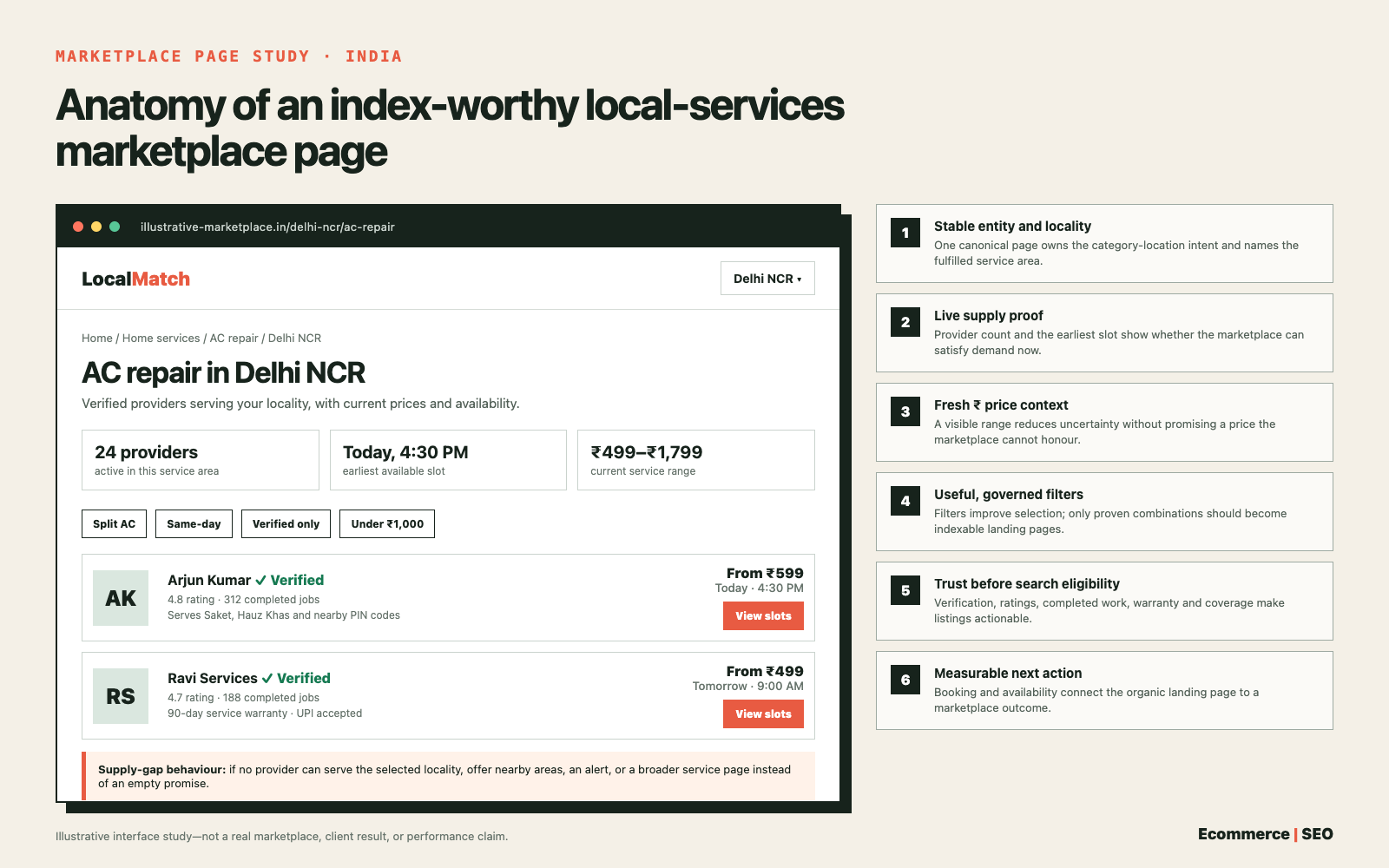
Illustrative interface study created for this guide. It is not a real marketplace, client result, or performance claim.
These examples show three different success actions: booking a service, contacting a property owner or agent, and enquiring with a supplier. Marketplace SEO should be designed and measured around the action that matters for that business.
How Should Marketplace Taxonomy and Site Architecture Be Designed?
Taxonomy determines which pages can own demand without competing with one another. Design it around entities and buyer decisions, not every label in the database.
Most marketplaces have five core entity types:
| Entity | Typical page | Question it answers |
|---|---|---|
| Category | plumbers, laptops, logistics providers | What type of supply is available? |
| Location or service area | city, locality, region, delivery area | Where can the buyer receive it? |
| Attribute | condition, capacity, speciality, amenity | Which characteristic changes the choice? |
| Seller | provider, merchant, recruiter, property manager | Who supplies it, and can they be trusted? |
| Listing or offer | product offer, job, property, service package | What exactly can the buyer act on now? |
Start with a category and location hierarchy that a user can understand:
Marketplace
├── Category
│   ├── Subcategory
│   └── Approved decision-changing attribute
├── Region
│   ├── City
│   └── Locality or service area
├── Verified seller
└── Active listing or offer
Not every intersection deserves a URL. Category × city may describe a stable market. Category × city × brand × colour × price band × sort order is more likely to describe a temporary interface state.
Give each search intent one canonical owner
Create an intent-to-page map before generating routes. Record the intended page type, canonical URL pattern, parent, allowed child combinations, supply threshold, and retirement rule. If two templates answer the same query with substantially the same inventory, choose one owner and consolidate the other.
Common conflicts include a city hub competing with a category-city page, a seller profile competing with a category page, editorial guides targeting transactional terms, and internal search pages duplicating approved landing pages. Resolve these conflicts in templates and routing rules, not through title rewrites after indexation.
Model products, sellers, and offers separately
In a multi-seller product marketplace, one product can have several seller offers. The product page should describe the shared item; each offer should contain seller-specific price, condition, fulfilment, and availability. Do not create several near-identical product pages merely because several sellers stock the item.
When variants genuinely need separate URLs, connect the group and variants consistently. Google supports both single-page and multi-page product-variant structures and documents ProductGroup, hasVariant, variesBy, and productGroupID for eligible product pages (Google Search Central, accessed September 2026).
Treat taxonomy migrations as search migrations
Category renames, city consolidation, seller deduplication, and attribute cleanup can change thousands of URLs. Before release, map old entities to new ones, preserve true equivalents with redirects, update internal links and sitemaps, and identify pages that have no valid replacement. Compare search demand, active supply, and outcomes at the old and new hierarchy levels before merging them.
Architecture is not finished when the navigation looks tidy. It is finished when each valuable demand set has one stable owner, users can reach current supply through crawlable paths, and lifecycle rules exist for every generated page type.
How Do You Map Buyer and Seller Demand?
A marketplace needs buyers and sellers, but the two groups search differently. Map their journeys separately. Then make sure a seller-acquisition page does not compete with the buyer category page for the same query.
Build the buyer demand map
Buyer queries normally progress from discovery to action:
| Buyer stage | Intent pattern | Best page type |
|---|---|---|
| Find | category, service, product, job | category or collection |
| Narrow | location, date, attribute, price | approved location or facet page |
| Compare | best, alternatives, versus, rates | comparison or editorial page |
| Evaluate | reviews, credentials, policies | seller, listing, or trust page |
| Act | buy, book, hire, apply, request quote | transactional listing or category |
Keyword tools show external demand, but onsite search shows where users struggle. Review zero-result queries, reformulations, heavily used filters, and terms that lead to successful actions. A repeated filter with strong outcomes may deserve a stable landing page. A high-volume query with no viable supply is a supply-acquisition brief, not a publishing brief.
Build the seller demand map
Seller queries follow a different path:
| Seller stage | Intent pattern | Best page type |
|---|---|---|
| Understand | how to sell, list, host, teach, drive | seller education |
| Evaluate | fees, earnings, requirements, coverage | seller commercial page |
| Prepare | documents, standards, photography, pricing | onboarding guide |
| Join | list now, become a provider, post a job | signup or onboarding page |
Keep seller and buyer language explicit in titles, headings, links, and navigation. A page about “selling vintage watches” should not compete with a buyer category for “vintage watches.” The seller page should answer fees, verification, payout, and listing requirements.
Build seller acquisition SEO as a separate growth engine
A marketplace cannot keep buyer pages useful without supply. Seller SEO should therefore cover the questions that determine whether the right providers join and become active:
- fees, commission, payout timing, and realistic earning mechanics,
- eligibility, documents, credentials, and verification,
- supported categories, service areas, and fulfilment expectations,
- onboarding steps and time to first live listing,
- listing-quality, photography, availability, and response standards,
- cancellation, dispute, safety, and account policies.
Measure seller content beyond form submissions. Track qualified applications, completed verification, first approved listing, time to first response, and activation within a defined period. A seller article that attracts many unqualified signups can make marketplace quality worse even when its organic traffic grows.
Turn onsite search into an SEO research system
Internal search logs expose marketplace-specific intent that general keyword databases miss. Useful fields include:
- query and reformulation sequence,
- selected filters and filter order,
- result count at query time,
- active-supply count,
- seller language versus buyer language,
- completed purchase, booking, application, enquiry, or other success event,
- time from search to outcome.
The behavior of people actively trying to find supply is often the best evidence for deciding which filters matter. Privacy-safe onsite data can reveal emerging terminology before external tools show meaningful volume.
Close the loop between Google demand and onsite behaviour
The marketplace search loop should run in both directions:
External search demand
        ↓
Organic landing page
        ↓
Onsite search, filters, and result quality
        ↓
Successful match or zero-result signal
        ↓
Recruit supply, improve the page, or remove it from search
        ↓
Retain, expand, consolidate, or retire the landing page
For each organic landing, store the page type, query theme where privacy permits, result count at the time of visit, filters used, seller response, and success event. Google Analytics supports recommended events such as search, generate_lead, qualify_lead, and purchase; marketplace-specific events such as booked service, accepted application, connected call, or opened WhatsApp conversation still need clear definitions and validation (Google Analytics Help, accessed September 2026).
The loop changes the team’s response to poor performance. High impressions and a high zero-result rate indicate a supply problem. Healthy supply with poor engagement suggests a relevance, trust, pricing, or experience problem. Low demand and low outcomes suggest consolidation or retirement rather than more copy.
Which Marketplace Pages Should Be Indexed?
Google defines crawl budget through two elements: crawl capacity and crawl demand (Google Crawling Infrastructure, 2026). In practice, choose which pages can appear in search. Keep low-demand, low-supply, duplicate, and unstable combinations available as onsite filters only when they still help users.
Use the demand and supply page check
The demand and supply page check is a planning method, not a Google ranking formula. Before allowing a page into Google, test it against seven questions:
- Demand: Search evidence supports the intent.
- Supply: Enough current, relevant options exist for this category, location, or other useful grouping.
- Differentiation: The page adds a distinct selection or useful decision support.
- Stability: The page can remain helpful despite listing churn.
- Trust: Sellers, reviews, prices, availability, and policies are credible.
- Discovery: Content and links are crawlable, and canonical and sitemap states agree.
- Outcome path: The visitor can compare, contact, book, apply, or buy.
There is no universal minimum listing count. Ten options may be strong supply for a specialist B2B service and poor supply for used cars in a capital city. Set thresholds by page type using zero-result rate, successful enquiries or bookings, time to outcome, geographic coverage, and conversion behaviour.
A prioritization heuristic can make discussions concrete:
page opportunity rises with demand, supply depth, uniqueness, freshness, and outcome potential, but falls as crawl cost increases
Treat this as a structured discussion prompt, not a numerical formula. Each team still needs first-party thresholds for its categories, geographies, and transaction model.
Worked example: a location-service page
Urban Company's public AC repair page for Delhi NCR shows the kind of evidence a location-service page can provide: visible services, prices in rupees, ratings, an earliest slot, a service process, warranty information, and a booking path. Those page elements support supply, trust, differentiation, and an outcome. Search demand and booking data would still need to be checked internally before treating the page as a model for every city.
Now compare it with a hypothetical page for a highly specific service in one Jaipur neighbourhood. If the page has no recorded searches, one inactive provider, no price or availability information, and no completed enquiries, it should remain an onsite filter. It should not become a Google landing page yet.
This comparison shows why listing count alone is not enough. A useful page helps a real buyer choose and act. A database combination merely exists.
Use the demand and supply decision table
| Demand | Supply | Search treatment |
|---|---|---|
| High | High | Build a stable landing page and index it first |
| High | Low | Acquire supply, but keep the thin page out of the index until useful |
| Low | High | Keep inventory accessible through UX filters, index only with evidence |
| Low | Low | Don't create an indexable page |
This matrix prevents a common error: interpreting keyword volume as permission to publish. Demand without supply creates disappointment. Supply without demand creates URL inventory that search systems must process for little return.
Use a page-type search eligibility table
| Page type | Default treatment | Index when | Keep out when |
|---|---|---|---|
| Core category | Index | Intent is distinct and supply is reliable | Category is duplicate or unsupported |
| Category × location | Conditional | Local demand and coverage pass the page check | Inventory is thin or moves constantly |
| Approved attribute page | Conditional | Attribute changes the decision and has demand | It is only a sort or cosmetic filter |
| Individual listing | Conditional | Unique, active, trustworthy, and useful | Copied, expired, unavailable, or too thin |
| Seller profile | Conditional | Verified profile has distinct inventory and proof | Empty, duplicate, or unverified profile |
| Internal search result | Usually noindex | Rarely, after conversion into a reviewed landing page | Raw query parameters and unstable results |
| Editorial guide | Index | It answers research intent with evidence | It repeats category copy |
| Reviewed landing page with temporarily empty supply | 200, review indexability | Demand persists, the page offers alternatives or alerts, and supply is expected to recover | The gap persists or the page no longer represents a viable market |
| Zero-result facet combination | 404 | Never index, do not create a search landing page | Supply and demand later justify a reviewed URL |
For collection and filter planning, see our category page SEO guide.
How Do You Build Marketplace Pages Programmatically?
Programmatic SEO for a marketplace is the controlled creation and maintenance of landing pages from structured demand, supply, and entity data. It is not permission to expose every database combination to Google.
The safest unit of scale is a reviewed template plus a publishing contract. The contract defines what data must exist, how fresh it must be, what makes the page distinct, and what happens when those conditions fail.
Define a publishing contract for each template
| Requirement | Example source | Failure action |
|---|---|---|
| Recognisable search intent | Keyword research, Search Console, onsite search | Keep the combination as an onsite filter |
| Active supply | Inventory or provider-availability table | Hold as candidate or move to scarce state |
| Entity identity | Approved category, location, seller, and attribute records | Reject the URL until duplicates are resolved |
| Unique decision data | Price range, availability, coverage, response time, comparison fields | Do not publish generic filler text |
| Trust eligibility | Verification, moderation, policy, review-quality records | Keep the seller or listing out of search |
| Accurate success route | Checkout, booking, application, call, or enquiry event | Fix measurement before scaling |
| Lifecycle owner | Product, supply, SEO, data, or trust team | Do not launch an unowned template |
Generate titles, headings, summaries, filters, and related links from the same current entities that produce the visible inventory. A unique sentence assembled from stale fields is not useful differentiation. A page becomes distinct when the combination changes the buyer’s options or decision.
Roll out page cohorts, not the entire URL universe
- Select one category, region, or page type with dependable supply.
- Calculate which candidate pages pass the publishing contract.
- Review a sample for duplicate intent, content accuracy, trust, and outcome paths.
- Release a defined cohort and record its URLs and launch date.
- Compare crawling, indexation, non-brand impressions, supply health, zero-result behaviour, and outcomes with a similar unreleased cohort.
- Expand, revise, or stop the template based on the result.
Add automated checks before every release. Compare page titles, entity combinations, visible summaries, and inventory overlap to catch near duplicates. Reject impossible location-category pairs and contradictory attributes. Pause generation when upstream inventory or moderation data is delayed. A page generator should be able to say “do not publish.”
Translate the contract into the marketplace stack
The policy stays the same even though implementation differs:
- On a custom or headless marketplace, the application, routing layer, and inventory service should share the same page-state rules.
- On a Shopify marketplace built with third-party seller tooling, distinguish Shopify product and collection URLs from vendor routes created by the marketplace layer.
- On WooCommerce with a multi-vendor extension, audit WordPress archives, product categories, products, vendor profiles, and extension-generated parameters as separate page types.
- On other hosted or extension-based platforms, identify which system owns canonicals, status codes, pagination, sitemaps, and seller pages before changing templates.
This article defines the decision model. A platform-specific implementation guide should document exact hooks, route patterns, extension behaviour, and release checks for that stack.
How Should Internal Links Change with Inventory?
Internal linking is how the marketplace tells users and crawlers which markets are currently important. It should react to supply and page state instead of remaining frozen after launch.
Google recommends linking from menus to categories, from categories to subcategories, and from those pages to products. It also notes that Googlebot generally does not submit queries into site search boxes, so pages that are reachable only through search may not be discovered reliably (Google Search Central, accessed September 2026).
Use an explicit relationship map:
| From | To | Link when | Remove or replace when |
|---|---|---|---|
| Category | Subcategory or approved attribute | Demand and supply make the child useful | The child falls below its retained-page rule |
| Region or city | Locality or service area | Coverage is active and geographically accurate | Supply leaves the area |
| Category page | Current listings | Listings are active, eligible, and representative | They expire, sell, close, or fail moderation |
| Seller profile | Seller inventory | Seller and offer are both active | Seller is suspended or inventory is unavailable |
| Listing | Related current options | Alternatives genuinely match the buyer’s need | The recommendation becomes stale |
| Editorial guide | Transactional page | The reader can act on the advice with current supply | The destination no longer fulfils the intent |
| Scarce or empty page | Nearby or broader alternatives | A real substitute exists | The substitute is also empty or irrelevant |
Prioritise links according to page state. Active pages can appear in navigation, hubs, related modules, and breadcrumbs. Candidate pages should not receive prominent SEO links. Scarce pages may keep links when they retain useful context and alternatives. Empty or retired pages should leave active modules and sitemaps together.
Do not let popularity modules create a feedback trap in which already visible pages receive every link while new but well-supplied markets remain buried. Reserve discovery paths for approved candidates, then promote them only after they pass the page check. Log which rule created each automated link so teams can diagnose sudden crawl growth.
Internal links are part of inventory operations. When availability, trust, or geographic coverage changes, links should change through the same event or scheduled process that updates page status and sitemaps.
How Should Marketplace URLs Change as Inventory Changes?
Google says crawl-budget management is mainly relevant to sites with roughly 1 million pages that change at a moderate rate or 10,000 pages that change daily, and it calls both figures rough estimates (Google Crawling Infrastructure, 2026). Large marketplaces still need clear page-status rules so the HTTP status, search eligibility, internal links, sitemap entry, and structured data do not contradict one another.
Use six page states
These six states connect inventory changes to the action the SEO and engineering teams should take:
| State | HTTP and index treatment | Links, sitemap, and content | Exit condition |
|---|---|---|---|
| Candidate | Not indexable | Exclude from XML sitemap, no prominent SEO links | Page check passes |
| Active | 200, indexable, self-canonical | Link, include in sitemap, show accurate data | Supply or outcome quality falls |
| Scarce | 200, retain only if still useful | Show alternatives, alerts, and recovery context | Recovers or reaches empty threshold |
| Empty | noindex or 404, based on onsite utility | Remove from sitemap, avoid dead-end links | New supply or retirement |
| Retired | 301 only to a true replacement, otherwise 404 or 410 | Remove from sitemap and active navigation | New supply justifies reactivation |
| Reactivated | Restore complete active state | Re-add links, sitemap, content, and valid markup together | Remains active or declines again |
Google recommends 404 or 410 for permanently removed content without a replacement. Redirect only when a real substitute exists (Google Search Central, accessed September 2026). Redirecting every expired listing to its parent category creates a weak response for users and can be treated as a soft 404.
Control filter URLs before they multiply
Filters can create an effectively infinite URL space when every selection produces a crawlable URL. Google says this can cause overcrawling and slower discovery of useful URLs (Google Crawling Infrastructure, 2025).
Start with a filter policy, not a canonical tag after launch:
- allow crawlable, indexable URLs only for approved combinations,
- keep parameter order consistent,
- prevent duplicate values and nonsensical combinations,
- return
404for zero-result filter combinations that have no onsite use, - block crawl of unneeded filter URL spaces when appropriate,
- use canonicals for genuine duplicates, not as the sole crawl-control tool,
- avoid linking to unlimited combinations.
robots.txt, noindex, and canonical tags solve different problems. A robots block controls crawling. A noindex directive requires crawling before it can be seen. A canonical is a consolidation hint. Blocking a URL in robots.txt can stop Google from seeing its noindex directive.
Make pagination and rendering discoverable
Google describes three JavaScript processing phases: crawling, rendering, and indexing (Google Search Central, accessed September 2026). Server-side rendering or pre-rendering remains useful because it helps users, crawlers, and bots that don't run JavaScript.
For pagination, give each page a URL and use crawlable <a href> links in sequence. Google generally doesn't click “load more” buttons or trigger user actions to find content (Google Search Central, accessed September 2026). Infinite scroll can remain the visual experience if equivalent linked pagination exists underneath it.
Keep sitemaps honest
Include canonical, indexable URLs that you want crawled. Split large sitemaps by page type or state so teams can diagnose category, listing, seller, and editorial coverage separately. Set lastmod only when meaningful content changed. A nightly timestamp on unchanged pages adds noise rather than freshness.
How Do UGC, Trust, Schema, and Merchant Center Fit?
Google documents two main classes of product structured data: product snippets and merchant listings (Google Search Central, 2025). Marketplaces should first improve the visible listing and trust data, then add markup that accurately reflects eligible page content. Schema cannot repair copied descriptions, stale prices, or unverifiable sellers.
Set minimum content standards for UGC
Seller-generated content gives marketplaces scale, specificity, and freshness. It also creates duplicate copy, missing attributes, weak photos, spam, and inconsistent naming.
Set separate standards for publishing a listing onsite and allowing it into Google. A listing may be allowed onsite but remain out of search until it has:
- a distinct title and description,
- required category attributes,
- usable images or evidence,
- current price, rate, or availability,
- verified location or service area,
- a credible seller identity,
- policy-compliant content,
- a clear transaction or contact path.
Structured fields often matter more than asking sellers to write longer descriptions. They support filters, comparisons, landing-page summaries, feeds, and quality checks from the same source of truth.
Build trust into the page template
Trust is part of marketplace usefulness. Show verification status, review provenance, transaction history where appropriate, response time, cancellation or return policy, fees, safety rules, and the date that availability was checked. Moderate reviews and explain what “verified” means.
Don't invent ratings or aggregate values. Mark up only content that users can see and that follows the relevant feature rules. Product pages may show price, availability, ratings, shipping, and returns when accurate (Google Search Central, 2025).
Add a trust and spam eligibility gate
Marketplace abuse is an SEO problem because a spam listing can create a crawlable URL, appear in a category, inherit internal links, and contaminate structured data before a moderator sees it.
The gate should detect at least:
- copied listings and duplicate seller accounts,
- fake locations, misleading prices, or unavailable inventory,
- manipulated reviews and unsupported credentials,
- lead spam, keyword-stuffed titles, and off-platform contact abuse,
- prohibited goods, unsafe services, or policy violations,
- sellers whose identity, service area, or fulfilment ability is unverified.
Use moderation states such as submitted, verified, active, restricted, suspended, and removed. Map each state to search eligibility, internal links, sitemap inclusion, structured data, and seller visibility. Publication inside the marketplace does not have to mean eligibility for Google.
Google recommends considering noindex for content from new or untrusted users and marking user-added links with rel="ugc" or rel="nofollow" where appropriate. It also warns that extensive user-generated spam can lead to manual action against affected portions of a site (Google Search Central, accessed September 2026).
Trust thresholds should be stricter where mistakes can harm users, such as home services, healthcare-related categories, jobs, financial offers, and property. State what verification covers. An identity check does not prove service quality, and a completed transaction does not make every review reliable.
Match schema to the page and transaction model
Use the most specific supported type that matches the visible entity. Product structured data belongs on a product-focused page, not a general category list. Merchant listing eligibility applies where a customer can purchase the product. Other marketplace types may use Google-supported search features such as JobPosting, Event, or VacationRental only when the page and eligibility rules fit. Schema.org types such as LocalBusiness or Service can describe visible entities, but they do not automatically create a Google rich result.
Product marketplaces can provide data through on-page structured data, Merchant Center feeds, or both. Google says using both can increase eligibility and help it verify product data (Google Search Central, 2025).
For an implementation checklist, see our Google Merchant Center and schema guide.
Multi-seller marketplaces need the appropriate Merchant Center account structure and seller identification. Google's marketplace guidance describes multi-client accounts. external_seller_id is required for offers in multi-seller accounts, but not for every marketplace account (Google Merchant Center Help, accessed September 2026). Confirm current eligibility and policy details for the account model before implementation.
How Does the Playbook Change by Marketplace Type?
This guide separates six marketplace models because inventory lifecycle, buyer urgency, and successful outcomes differ by type. Google's Product documentation alone distinguishes two product-result classes based partly on whether a shopper can purchase on the page (Google Search Central, 2025). The correct playbook follows the transaction model, not the word “marketplace.”
Product marketplaces
Start with category and brand pages, then add product and approved attribute pages. Standardize identifiers, variant relationships, condition, shipping, returns, price, and availability. Individual listings should enter Google only when their pages remain distinct and purchasable. Merchant Center may extend discovery, subject to marketplace eligibility and feed policy.
Local service marketplaces
Category × location pages can be valuable when service coverage is real. Use provider count, verified service areas, response behavior, price or rate context, and availability. Avoid creating every neighborhood combination before supply exists. The success event may be a booked job, accepted quote, or valid lead.
Classified marketplaces
Listings turn over quickly, so stable category and location pages carry more long-term value. Define how sold and expired items move through scarce, empty, and retired states. Keep historical pages only when they retain clear research value and don't misrepresent availability.
Booking and rental marketplaces
Availability is date-sensitive. Build durable destination, property-type, and use-case pages, then update them with current supply. Avoid indexing every date combination. The page should still help when a specific date has no results by offering nearby dates, alerts, or sensible alternatives.
Job marketplaces
Freshness is strict. Expired roles should leave active sitemaps and receive the correct removal treatment. Stable occupation, skill, company, and location pages can aggregate current jobs and career guidance. Use JobPosting only on eligible individual job pages with accurate expiry information.
B2B marketplaces
Supply may be sparse but valuable. Five verified suppliers with certifications, capacity, regions served, and response data can be more useful than hundreds of thin consumer listings. Decision support, quote requirements, compliance, and lead quality often matter more than instant checkout.
What Changes for Marketplaces Serving India?
The core model does not change in India: index a page when demand, current supply, trust, and an outcome align. Execution becomes more demanding because one commercial market may contain several location systems, scripts, languages, payment preferences, and fulfilment conditions.
Model service areas more precisely than city names
Decide whether a marketplace fulfils by physical address, delivery radius, PIN code, provider service area, or a combination. A seller based in Gurugram may serve parts of Delhi NCR without having a branch in each locality. A product may ship nationally but have different delivery dates or cash-on-delivery eligibility by PIN code.
Use city, locality, district, state, and PIN-code data as operational entities. Do not automatically publish every combination. “Tier 1,” “Tier 2,” and “Tier 3” can help internal planning, but they are not substitutes for evidence of demand and coverage at the actual location represented by a page.
For each location page, show the scope accurately: areas served, delivery or response expectations, active provider count where useful, and nearby alternatives. Avoid claiming “near me” relevance when the user’s location has not been established.
Research language, script, and transliteration separately
Indian buyers may search in English, Hindi, another regional language, a Latin-script transliteration, or a mixed-language phrase. They may also use an alternate spelling, older locality name, landmark, or neighbouring city for the same service area. Do not translate every page mechanically and assume the demand is equivalent. Research how buyers and sellers describe the category and place in each target market, then create separate language URLs only when the marketplace can maintain their content and experience.
Google reports that about half of its users are multilingual and specifically describes Indian users searching for Hindi content with Latin-script queries. For multilingual sites, Google recommends separate URLs, hreflang, and visible language or region links rather than IP-based adaptation (Google multilingual search, Google multi-regional site guidance, accessed September 2026).
Translate category definitions, attributes, safety information, policies, and conversion steps together. A Hindi landing page that switches to an English-only verification or checkout flow is not a complete language experience.
Protect the experience on mobile and constrained connections
Treat the first useful marketplace result as the performance priority: page identity, location, current options, price or rate context, trust, and the next action. Do not make buyers wait for every recommendation carousel, map marker, review, and tracking library before they can evaluate supply.
Test representative low-powered devices and constrained network profiles, not only office Wi-Fi and flagship phones. Keep server-rendered or pre-rendered essentials usable, reserve space for images and inventory modules, compress seller media, and make call, messaging, booking, or purchase actions stable during loading. Performance should be segmented by page type and geography because a fast homepage does not prove that listing-heavy locality pages work well.
Make fulfilment and payment conditions visible
Where they affect the choice, show current prices in INR, taxes or fees, delivery coverage, estimated fulfilment, return or cancellation rules, and available payment methods such as cards, UPI, or cash on delivery. These are marketplace data fields, not paragraphs to update manually.
Check price and availability freshness by page type. A B2B indicative price may need a quote date and unit. A rental needs date-specific availability. A local service needs a valid service area and booking window. A product offer needs current stock and delivery eligibility.
Seasonal events can also change demand and supply at different times by category and region. Record the observation period when publishing Diwali, wedding-season, monsoon, school-admission, agricultural, or travel demand findings. Do not present one season’s marketplace data as a timeless national trend.
Attribute phone, callback, and messaging outcomes
Many marketplace journeys leave the browser before the transaction is complete. Define when a click-to-call, callback request, phone connection, messaging click, qualified conversation, or offline sale counts as an outcome. A WhatsApp click is not automatically a valid lead, and a call button click is not proof that buyer and seller connected.
Pass landing-page and campaign identifiers into the lead record where consent and platform rules allow. Reconcile them with call, messaging, CRM, booking, or order status. Separate initiated contacts from connected, qualified, and completed outcomes.
Distinguish a marketplace from an open network
ONDC is not simply another marketplace website. Its official materials describe an open network based on open specifications, independent of one platform or marketplace (ONDC, accessed September 2026). Participants can operate buyer or seller applications while transactions move across the network.
The SEO implication is ownership. Identify which participant owns the crawlable buyer-facing page, product data, canonical URL, availability update, trust statement, and measured outcome. Do not create duplicate public pages across network participants without a clear user purpose and source of truth.
What Information Can Only Your Marketplace Publish?
Google's people-first guidance asks whether a page provides original information or analysis and whether it adds substantial value beyond other results (Google Search Central, accessed September 2026). For a marketplace, the strongest answer is first-party evidence that helps a buyer make a decision.
In this guide, information gain means giving the reader something useful that a generic SEO article cannot provide. It is not a known Google formula. It comes from the marketplace's own searches, active supply, prices, availability, response times, trust checks, and completed transactions.
What this guide adds beyond standard marketplace SEO advice
| Common stopping point | Additional operating decision in this guide |
|---|---|
| Find keywords and create category pages | Check external demand against active supply, trust, stability, and a measurable outcome before publication |
| Index or noindex a URL | Manage candidate, active, scarce, empty, retired, and reactivated states across status codes, links, sitemaps, content, and markup |
| Generate long-tail pages from database combinations | Require a publishing contract, QA sample, controlled cohort, pause rule, and lifecycle owner |
| Add internal links to important pages | Change automated links when inventory, seller eligibility, or service coverage changes |
| Report organic sessions or rankings | Connect pages to qualified marketplace outcomes, contribution, and an incrementality test |
| Mention India through company examples | Change location, language, payment, fulfilment, contact attribution, and network-ownership decisions for Indian execution |
These frameworks create information gain for the reader. A marketplace creates information gain for its buyers by publishing current facts and analysis that only its own activity can support.
Replace generic category copy with platform facts
A marketplace has a data advantage that ordinary publishers don't. Useful, privacy-safe facts may include:
- active option count by location or category,
- median and percentile price or rate distributions,
- sample size and observation date,
- typical availability windows,
- verified response times,
- completed-transaction or booking counts,
- provider coverage and certification mix,
- anonymized demand gaps and zero-result trends.
Methodology matters. State the time window, sample size, inclusion rules, geography, and refresh date. Don't present live inventory as a timeless market statistic. Don't publish thin slices that expose personal or commercially sensitive data.
Build pages that reduce uncertainty
An indexable page should help a user answer a question that listings alone cannot. Examples include:
- What is a realistic price range here?
- How quickly can I get a response?
- Which attributes change availability or price?
- What credentials should I verify?
- Which nearby market has better supply?
- What happens after I book, apply, or request a quote?
Could a generic publisher answer these with the same precision? If yes, the page probably needs more first-party evidence.
Publish useful market reports
Aggregate reports can reveal category growth, regional supply gaps, seasonal booking patterns, or changes in buyer requirements. Publish a clear method and downloadable tables where safe.
MagicBricks Research provides an Indian example. Its Bengaluru report combines search activity, active listings, locality demand, property type, and price movement. A generic publisher can comment on Bengaluru property. Only a marketplace with enough first-party activity can show how demand and available listings moved within its own platform and explain the sample behind the finding.
Google's AI-search guidance recommends unique, expert-led, non-commodity content and doesn't require special AI markup (Google Search Central, 2026). Clear definitions, self-contained findings, dates, methods, and source attribution make facts easier for people and machines to evaluate.
For reporting, group indexed category and location pages by search demand and active supply. Then compare successful-outcome rate with zero-result rate. This shows whether the platform is attracting buyers it can actually serve.
How Do You Run a Marketplace Page Audit Without Inventing Data?
A useful marketplace audit joins search, inventory, trust, and outcome data at URL level. It should not fill missing fields with estimates or turn a hypothetical example into a case study.
Use the marketplace page-eligibility worksheet to create one row per candidate or active search landing page. The blank template is designed for first-party data; it contains no assumed thresholds or performance figures.
Join four sources of truth
- Search evidence: landing-page impressions, clicks, query themes, index status, and crawl observations.
- Supply evidence: current listing or provider count, freshness, coverage, price or availability completeness, and result count.
- Trust evidence: verification state, moderation status, review quality, policy violations, and seller eligibility.
- Commercial evidence: purchase, booking, application, connected call, qualified enquiry, seller activation, revenue, or contribution outcome.
Search Console bulk export can provide daily site, URL, and query performance in BigQuery and can be joined with other data sources. Google notes that the export is not affected by the daily row limit applied to the standard interface, although anonymised queries are still excluded (Google Search Central, 2023).
Keep the worksheet fields operational:
| Field group | Record | Why it matters |
|---|---|---|
| Identity | URL, page type, category, location, language, canonical owner | Prevents duplicate intent and unclear ownership |
| Demand | Evidence source, non-brand query theme, impressions, trend window | Shows whether a stable external need exists |
| Supply | Active options, freshness rule, verified-seller coverage, zero-result behaviour | Tests whether the marketplace can fulfil the need |
| Page quality | Unique decision data, crawl path, template state, moderation status | Separates a useful market page from a generated combination |
| Outcome | Defined event, qualified outcomes, revenue or GMV where applicable, assisted outcomes | Connects search visibility to marketplace value |
| Decision | Index, retain, improve supply, consolidate, noindex, or retire | Gives every row an action and owner |
| Review | Owner, decision reason, next review date | Keeps the audit from becoming a one-off spreadsheet |
Fill it in through a repeatable sequence:
- Export the candidate and currently indexable URLs with their page type and entity IDs.
- Join search data over a stated window; mark absent evidence as “not measured,” not zero.
- Join inventory at the same grain and record the freshness rule used to define “active.”
- Add trust and outcome fields from moderation, lead, booking, order, or seller-activation records.
- Review decisions by page-type cohort, assign an owner, and set the next review date before changing search eligibility.
Preserve the source date for each join. Comparing a current inventory count with search and revenue from an unrelated period can produce a confident but false conclusion.
Decide without a universal threshold
Calibrate thresholds from the marketplace’s own successful pages. Compare strong and weak cohorts within the same page type instead of importing a listing-count rule from another business.
| Evidence pattern | Likely decision |
|---|---|
| Demand, supply, trust, and outcomes are healthy | Retain and consider controlled expansion |
| Demand is healthy but supply or coverage is weak | Recruit supply; keep the thin candidate out of search |
| Supply is healthy but the page attracts little distinct demand | Keep it accessible through navigation or filters; test before indexing |
| Search traffic arrives but zero results or invalid leads are high | Repair matching, trust, or availability before adding pages |
| Two pages serve the same intent and inventory | Choose one owner and consolidate |
| Demand and useful supply have disappeared | Remove links and sitemap entry; noindex, 404, 410, or redirect according to the lifecycle rule |
When data is unavailable, write “not measured” and assign the instrumentation owner. That is more useful than a fabricated benchmark because it exposes the exact dependency blocking a decision.
How Do You Measure and Execute Marketplace SEO?
Clicks, impressions, and rankings do not show whether a marketplace fulfilled the visitor's need. A useful scorecard connects search visibility to current inventory and a business outcome. Start with these page-type measures, then adapt the 90-day sequence below to your release cadence and data access.
Track outcomes by page type
| Metric | Definition | What it diagnoses |
|---|---|---|
| Organic success rate | Purchases, bookings, applications, or valid enquiries from organic marketplace landings ÷ eligible organic marketplace landings | Whether search demand becomes marketplace value |
| Index efficiency | Indexed URLs with impressions ÷ total indexed URLs | Whether indexed inventory earns visibility |
| Impression yield | Non-brand impressions ÷ indexed URLs | Weak templates hidden by sitewide totals |
| Fresh-supply coverage | Organic landing pages passing the active-supply threshold ÷ organic marketplace landing pages | Pages that rank but break their inventory promise |
| Post-click zero-result rate | Organic sessions encountering no viable option ÷ organic marketplace sessions | Demand the platform can't fulfill |
| Time to outcome | Time from organic landing to the defined success event | Friction between discovery and outcome |
| Qualified lead rate | Connected and accepted enquiries ÷ organic enquiries | Lead spam, poor matching, or weak buyer intent |
| Seller activation rate | Sellers reaching the agreed active state ÷ organic seller applications | Whether seller SEO creates usable supply |
| Organic GMV or revenue | Completed marketplace value attributed to eligible organic landings | Commercial output, segmented by page type and market |
| Contribution after variable cost | Organic revenue or commission less attributable fulfilment, incentive, support, and acquisition costs | Whether organic growth is economically useful |
| Assisted outcome rate | Outcomes where organic discovery preceded a later channel or offline completion | Marketplace journeys that do not finish in one session |
Segment every measure by categories, locations, facets, listings, sellers, and editorial pages. A sitewide average can hide a category hub that works and millions of listing URLs that never earn an impression.
Build attribution around marketplace reality
Define the outcome before configuring reports. Product marketplaces may use completed orders and GMV. Service marketplaces may use fulfilled bookings. Job platforms may use qualified applications. B2B directories may use accepted enquiries or opportunities rather than every submitted form.
Keep brand and non-brand discovery separate, and distinguish new demand from repeat buyers returning through search. Report repeat transactions separately so an SEO landing is not credited as new acquisition every time an existing buyer returns through a branded query. Where transactions complete by phone, messaging, an app, or a seller’s system, carry a first-party landing or lead identifier into the downstream record when consent and policy allow. Reconcile initiated events with connected and completed outcomes.
Google Analytics enhanced measurement can record outbound clicks and onsite search interactions, but marketplace-specific qualification and fulfilment states require an event and data-layer design tied to the underlying record (Google Analytics Help, accessed September 2026).
Test incrementality before claiming that SEO caused growth
Attribution shows which recorded journey included organic search. Incrementality asks what would have happened without the SEO change.
Release a defined cohort of eligible pages while holding back a comparable group where practical. Record demand, supply, trust, and outcomes before the release. Compare changes over the same period, note other product or marketing changes, and keep the URL sets fixed for the test. If a holdback is not feasible, use staged regional or category rollouts and state the limitation.
Do not treat all organic GMV as incremental. Existing users can return through branded search, and newly indexed pages can shift clicks from another page on the same site. Track cannibalisation and contribution by page type before expanding the template.
Days 1–30: define and diagnose
Agree on the success event for each marketplace flow. Build the buyer and seller demand maps. Inventory URL patterns, indexed states, sitemaps, canonicals, status codes, render behaviour, and internal links. Join Search Console landing data with active supply and outcomes.
Choose initial thresholds for demand, supply, freshness, trust, and stability. Do not apply them sitewide yet. Test them against strong and weak category or location pages. Assign owners from SEO, product, engineering, data, supply, and trust teams.
Days 31–60: gate and repair
Apply the demand and supply page check to one high-value category or region. Create the page-type table and six page-state rules. Fix contradictory states, such as noindex URLs in sitemaps, expired listings with active markup, and empty pages with self-referencing canonicals and prominent links.
Control how filters create crawlable URLs. Add crawlable pagination. Render essential content and links reliably. Improve the listing-quality fields that feed categories, structured data, and trust modules.
Days 61–90: expand and learn
Launch the strongest stable pages. Add first-party facts with methods and refresh dates. Update sitemaps by state and page type. Monitor crawl patterns, indexed coverage, impressions, fresh-supply coverage, zero-result rate, and successful outcomes.
Test one category or region before changing the entire site. Record the start date, affected URL set, search visibility, live supply, zero-result rate, and completed outcomes. Compare it with a similar unchanged group where possible.
Review page eligibility every month
Run the page check when a page is created and whenever its supply conditions change. A monthly review should identify pages becoming scarce or empty, candidates ready to enter search, and filters creating unexpected crawl volume.
Use our ecommerce keyword research guide to build the external-demand side of the audit.
Which Topics Need Their Own Supporting Guides?
This pillar supplies the operating model and the decisions that connect its parts. Implementation detail should live in focused guides so teams can use the instructions without searching through one enormous article.
| Supporting topic | What the dedicated guide should solve |
|---|---|
| Programmatic SEO for marketplaces | Data contracts, route generation, QA, cohort releases, and pause controls |
| Marketplace faceted navigation | Parameter policy, crawl traps, canonicals, noindex, and approved facets; start with the technical ecommerce SEO guide |
| Marketplace taxonomy and URL design | Category ownership, location hierarchy, entity relationships, migrations, and cannibalisation |
| Marketplace internal linking | Automated relationship rules, state changes, discovery queues, and monitoring |
| Seller-generated content SEO | Required fields, moderation, duplication, listing quality, and search eligibility |
| Marketplace schema and feeds | Page-type eligibility, product offers, multi-seller feeds, and validation; start with the Merchant Center and schema guide |
| Marketplace SEO measurement | Event design, warehouse joins, offline outcomes, contribution, and incrementality |
| Marketplace SEO in India | Location, language, transliteration, fulfilment, payment, and contact attribution |
| Marketplace SEO for local services | Service areas, provider availability, price context, trust, and booking quality |
| Real-estate marketplace SEO | Locality pages, inventory churn, agent or owner trust, contact quality, and market reports |
| B2B marketplace SEO | Sparse but valuable supply, certification, capacity, quote requirements, and lead validation |
| Job marketplace SEO | Expiry, occupation and location hubs, application quality, and JobPosting rules |
| Classified marketplace SEO | Fast listing turnover, sold states, duplicates, and durable category-location hubs |
| Rental and booking marketplace SEO | Date-sensitive availability, durable destination pages, alternatives, and booking outcomes |
| Marketplace information-gain research | Privacy-safe first-party reports, methods, refresh schedules, and citation-ready datasets |
The dedicated guides should inherit the same central rule: a URL earns search visibility only when it represents a useful market that the platform can currently serve. They should deepen the implementation, not introduce a conflicting strategy.
Marketplace SEO FAQs
These answers cover the indexing and implementation questions marketplace teams encounter most often. Usefulness depends on demand, live supply, trust, and an achievable outcome, not a universal listing count.
Is marketplace SEO the same as Amazon, Etsy, or Facebook Marketplace SEO?
No. Marketplace SEO usually means growing an owned two-sided or multi-sided platform through external search. Amazon, Etsy, and Facebook Marketplace SEO concerns ranking a seller's listing inside those platforms. “SEO marketplace” may also describe a site selling SEO services, so define the scope before applying tactics.
Should every marketplace listing be indexed?
No. Index listings only when they are active, distinct, trustworthy, crawlable, and useful enough to satisfy a searcher. Thin, copied, expired, or unavailable listings should not remain indexable by default.
How many listings does a page need before indexation?
There is no universal count. Set a threshold by category, geography, price, urgency, and outcome type. Use first-party match rate, zero-result rate, time to match, freshness, and conversion data. A niche B2B category can be useful with fewer verified suppliers than a broad consumer category needs.
What should happen when a marketplace page has no inventory?
Keep a useful, stable landing page at 200 during a short supply gap. Whether it remains eligible for search should depend on persistent demand, useful information that remains on the page, and the expected recovery window. Use noindex when the page still serves users but the page is persistently not useful for search. Use 404 or 410 when the resource has no useful purpose and no replacement. Google recommends 404 for zero-result filter combinations and warns against redirecting them to a generic page (Google Crawling Infrastructure, 2025).
Does a React marketplace need server-side rendering?
Not strictly, because Google renders JavaScript. Yet Google processes JavaScript through three phases and still recommends server-side rendering or pre-rendering for speed and wider bot access (Google Search Central, accessed September 2026). Ensure essential content, links, canonicals, and status behavior appear reliably.
Should internal search-result pages rank?
Usually not. Raw search URLs are unstable, duplicative, and capable of generating huge URL spaces. Convert proven queries into reviewed category, location, or attribute pages only after they pass the demand and supply page check. Keep the rest useful inside the product without making them Google landing pages.
Does a marketplace need special markup for AI search?
No special AI markup is required. Use accurate, eligible structured data for the visible entity and publish original, well-sourced information. Google's generative-AI guidance recommends unique, expert-led content rather than a separate markup system (Google Search Central, 2026).
Build Search Visibility Around Successful Matches
A durable marketplace SEO system has four parts: stable demand pages, accurate listings, clear page-status rules, and measures tied to purchases, bookings, applications, or valid enquiries. Together, they keep search visibility aligned with what the platform can actually fulfil.
Start with one category or location where demand and supply are already healthy. Map buyers and sellers, run candidate pages through the seven-question check, repair conflicting page states, and measure completed outcomes from organic landings. Then expand. This produces fewer pages than publishing every database combination, but each page makes a clearer promise and has a better chance of keeping it.
The checks in this guide are planning methods for marketplace teams. They are not Google formulas. Their value should be tested against your own inventory, crawl data, search demand, and marketplace outcomes.
Need help applying this to a custom marketplace? Talk to EcommerceSEO.in about an SEO audit.